I’m not trying to do any horn-tooting here, but just trying to make a point: I have worked with over 200 editors with literary journals, as they have revised and published my work in the past fifteen years. So, I’ve had a bunch of experience working with journals and editors. A few years ago, Two Hawks Quarterly (THQ) published my essay, “In Fine Spirits,” and I was impressed with the work in the issue and the editing process my piece went through with their editor-in-chief, Deborah A. Lott. I was ecstatic to be a part of that journal. From this experience, I became curious about the different aspects of what makes the journal and what all goes into creating work that speaks open truths with clarity and beauty. I decided to have a conversation with Deborah to understand more of this journal and her work and perspectives on the writing community.
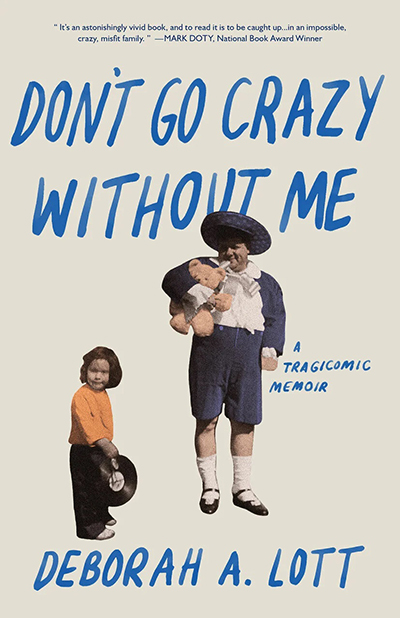 Deborah is a fantastic writer. She has numerous publications and a very compelling memoir out about the dynamics between her relationships with her parents, Don’t Go Crazy Without Me. Writing with both raw honesty and wit, Deborah’s work explores different aspects of the lived experience of mental health and navigating trauma. Her gritty and yet astonishingly well-crafted work is reflected in the pieces that THQ publishes. I had the pleasure to ask Deborah some questions about this outstanding journal.
WOW: For writers who might not have heard about Two Hawks Quarterly, can you tell me what is the overall tone of the journal?
Deborah: I would say that the tone is serious, which is not to say that we don’t publish humorous works. However, we publish work that takes itself seriously, meaning that authors have taken the time to write and rewrite and rethink and rewrite again. We publish poetry, fiction, and creative nonfiction that is very well crafted, fully imagined, and that makes us both think and feel. We like work that takes chances and asks hard questions about the status quo. I’m not sure that I can describe its tone in a word, but I guess the closest words would be “layered,” “deep,” “probing,” and “brave.”
WOW: I absolutely love that! It presents an interesting question in my head, though. Why is it called Two Hawks Quarterly?
Deborah: The journal was started by an intrepid group of undergraduate creative writing students at Antioch University in 2007. It came from the ground up, not the top down. Flint, one of their editors (who has gone on to publish and write a lot of wonderful work), wrote a poem about two hawks on a wire having sex. There was a line in it about pressing a bar because sometimes a pellet of rapture drops. We kept the title “Two Hawks” because we are still attracted to the prospect of that pellet of rapture.
WOW: I read the poem and see what lines you’re talking about. I have to quote some of this poem because it’s fantastic: “every day I push the bar again and again / because sometimes, some days, a pellet of rapture drops ... as if the answer to any question you might ask is this feathered body.” But the ending totally represents the experience of reading THQ: “what is there to do, but kneel / and turn the pages of the sky, servant to this joy.” That’s some damn good stuff and really does represent the strength of both rawness and beauty in the pieces the journal publishes. Can you talk a little more about the pieces in the journal? What types of pieces shine best when you are looking through submissions?
Deborah: I think writers need to be aware of what the evaluation process is like. There are usually hundreds of pieces in our submittable inbox. We are reading through them at a pretty quick pace, trying not to be jaded but getting kind of groggy, just from the sheer number of words going through our brains. Then, suddenly, an opening line or an image from a poem, or a narrative voice stops us in our tracks. Usually it’s work that reveals a high level of craft, but more importantly it feels authentic, original, urgent. The pieces that grab us have a sense of what poet and guest editor for THQ, Doug Manuel, calls “velocity.” They convey energy, movement, a compulsion to tell us something that we may never have felt or thought before. The Russian critic Viktor Shklovsky talks about the sense of “defamiliarization,” which writer Elif Batuman describes in a New Yorker profile about Japanese writer Sayaka Murata, as, “making the reader see the world as if for the first time.” I think really great works of art all have that defamiliarizing quality. When a poem or a piece of flash or an essay accomplishes this, we have to publish it.
“The pieces that grab us have a sense of ... ‘velocity.’ They convey energy, movement, a compulsion to tell us something that we may never have felt or thought before.”
WOW: For editors and readers of the journal, that must be an amazing experience to witness this writing. How such brave and well-crafted pieces can make the reader have a shift in perspective. So where are you in this process? What sort of work do you do for the journal?
Deborah: As faculty adviser, editor-in-chief, I read nearly every submission. I lead our team of student editors, undergraduates, and some graduate students in weekly discussions of submissions. When we disagree about the merits of a piece, I try to facilitate our seeing it through one another’s eyes. Sometimes we do research to look up a particular plant or bird or place described in a piece so that we can understand better the context of a particular work. Our conversations can be far-ranging. If we find a piece that is not quite there yet but that we believe in, we’ll give the author notes and ask to see a revision. I usually take the lead in these developmental edits with authors. I write or approve the notes and all our communication with the author. I also oversee every copyedit.
WOW: For my piece, “In Fine Spirits,” we went back and forth on edits about four times. It was a really great experience for me to see the depth, attention, and intention that was put into the edits. I’m assuming my experience wasn’t an oddity for the journal. Can you describe for readers what the editing process is like when an author has a piece accepted by the journal?
Deborah: I do remember the joys of editing that piece. In your case, all we really wanted was MORE Chelsey. You were writing about such sensitive and complicated material—an assault, PTSD, addiction, self-harm, sexual attraction to one’s therapist—and the therapist’s doppelgänger, the narrator’s neighborhood bartender—the piece could have easily devolved into woe is me self-pity. Instead the narrator never lost her sense of irony and perceptiveness of everything around her. Your unique voice and self-deprecating wit make readers want to follow you down any dark hole you find yourself in.
Every piece receives a careful copyedit. In the case of poetry, for example, we look at line breaks, consistency of punctuation, spelling, capitalization, etc. For prose pieces, we might suggest some cuts or moving a paragraph or a sentence, or even beginning or ending a story somewhere else. We may ask for clarification of ambiguous sentences or suggest deletions of redundancies. We often read work aloud in the course of our editing process. Even long pieces of fiction might get read aloud. Because a developmental edit is so time-consuming, we only embark on that process if we feel a piece is almost there and we can ask questions that will help an author see clearly where it needs to go or what is missing. Authors approve every edit, even if it’s only the addition or deletion of a single comma.
WOW: Okay, yeah. That was absolutely my experience. And that’s such an important amount of detail and care put into one piece of writing! No wonder the journal publishes such exquisite pieces. That must take a lot of time, though. What’s the turnaround time at the journal from submission to publication?
Deborah: That’s a tricky question. It depends on how many submissions are in the inbox at any one time and how quickly we can get through them. We publish twice a year now, in Fall and in Spring. We would like to say that no piece languishes in our box for longer than twelve weeks, but we can’t always make that happen. We try to move through the box as quickly as we can without giving short shrift to any submission with promise.
WOW: I think writers really appreciate the sort of care and dedication that is put into the reviewing and editing process, regardless of time. And honestly, twelve weeks is pretty average for a journal. Thinking about this editing process, for me, I learned how to write from seeing how other people edited my work, so of course those editors hella influenced me. What has influenced you not just as a writer but also as an editor?
Deborah: Wow, that is a tough question. So much! So many writers I’ve loved, and paintings, and music, and dogs’ faces! My very first boss was at a book publisher in Cambridge, MA, who had us proofread every book backwards. I guess I’d say the lessons I’ve taken away from all these influences is to value humility in writers and editors. I try to allow myself to stay open to being surprised, to allow work to affect me in unexpected ways. To not get smug or jaded. To not be afraid of genuine emotion. To recognize how subjective the whole process of evaluating a work and curating a journal is. Sometimes I’ll think I know what a poem is about, and a student will parse it in a meeting, and I’ll realize there’s a whole other equally or more valid way of reading the same poem. I am being influenced all the time; we are all works in progress.
“I try to allow myself to stay open to being surprised, to allow work to affect me in unexpected ways. To not get smug or jaded. To not be afraid of genuine emotion. To recognize how subjective the whole process of evaluating a work and curating a journal is.”
WOW: Oh totally! We are works in progress. I love that concept. It’s all about discovering ourselves as we write, which can be hard when we need to dig deep. What subject matters do you challenge yourself most to write about?
Deborah: I’m primarily a memoirist and a writer of nonfiction. I’m most challenged to write in the midst of confusion. It took me way too many years to write my coming-of-age memoir, Don’t Go Crazy Without Me. Right now, I’m trying to write about my own troubled relationship to my body and about disorders at the intersection of mind/body that are not fully understood by the fields of medicine and psychology. I know that the only way out is through—you get clarity through the process of writing. You don’t have it and then write from that position. Still, it’s hard to articulate “not knowing” and invite the reader into your own process of making sense.
WOW: Thinking about the future and not knowing what we’re really writing about until we’re writing it, I’m curious if the shape and standing of literary journals are the same. We might not know their fate, but as each piece is published, the journal transforms some. That said, current politics might challenge that. What do you hope to see for the future of the journal?
Deborah: Two Hawks Quarterly has already survived longer than many literary journals. I’m very worried about our fate as I’m worried about the fate of every literary journal that relies on funding from federal grants, private donors, and the kindness of universities that continue to recognize their value. In general, literary journals don’t make money, they don’t have thousands of readers, or sell products. They don’t make news. I feel a sense of jeopardy and urgency for the survival of any artistic endeavor that isn’t making money or selling products in our current society. I have anxiety for any journal speaking truth to power. I hope to survive and to keep publishing work that makes us gasp at its beauty, its clarity, its urgency.
“I feel a sense of jeopardy and urgency for the survival of any artistic endeavor that isn’t making money or selling products in our current society. I have anxiety for any journal speaking truth to power. I hope to survive and to keep publishing work that makes us gasp at its beauty, its clarity, its urgency.”
WOW: That is so true! How do you think writers can keep the writing community together in such turbulent times?
Deborah: For all the failings of Zoom, it has allowed writers from all over the world to engage with one another and one another’s works. We need to continue to do so. Many writers are introverts, and our impulse in turbulent times is to withdraw or silence ourselves. We can’t do that. We have to keep supporting one another and publishing work that speaks truth to power. We have to buoy one another up, buy one another’s books, read and support literary journals and books that come out from small presses and don’t get the media blitz that large publishers can pay for. We have to give one another the benefit of the doubt and not let disagreements about small things get in the way of our larger shared purpose.
WOW: Deborah, honestly, I feel like this interview and your thoughts and perspectives on the writing and editing process as well as the ways in which literary journals can challenge writers to really work on their craft and perfect their pieces is a part of this community. It’s like we’re getting to help each other and cheer one another on as we open up about our own processes. So thank you so much for contributing to the writing community here. Let’s keep it going.
Writers! Two Hawks Quarterly publishes poetry, fiction, creative nonfiction, flash, genre X (experimental), and artwork. They will be open for submissions starting October 1st! You can find their submission guidelines here: https://twohawksquarterly.com/written-submission-guidelines/
***

Chelsey Clammer is the award-winning author of the essay collections Human Heartbeat Detected (Red Hen Press, 2022; finalist for the Memoir Magazine Book Awards 2023), Circadian (Red Hen Press, 2017; winner, Red Hen Press Nonfiction Manuscript Award), and BodyHome (Hopewell Publications, 2015). Her work has appeared in Salon, The Rumpus, Brevity, and McSweeney’s, among many others. She was the Fall 2019 Jack Kerouac Writer-In-Residence through the Kerouac Project. Chelsey teaches online writing classes with WOW! Women on Writing and is a freelance editor. Visit her website at: www.chelseyclammer.com.