few years ago, a friend of mine—an experienced writer who could outline a feature in her sleep—confessed something that sounded almost childish: she had started dreading the moment she opened a blank document. Not because she lacked ideas, but because they arrived in droves. Each one demanded to be the 'right' one. The first sentence felt like a public statement, and every subsequent paragraph felt like a negotiation with an invisible judge.
She tried the usual solutions: better prompts, stricter schedules and mantras such as 'just write.' Some of these helped for a day. Then the tightness returned.
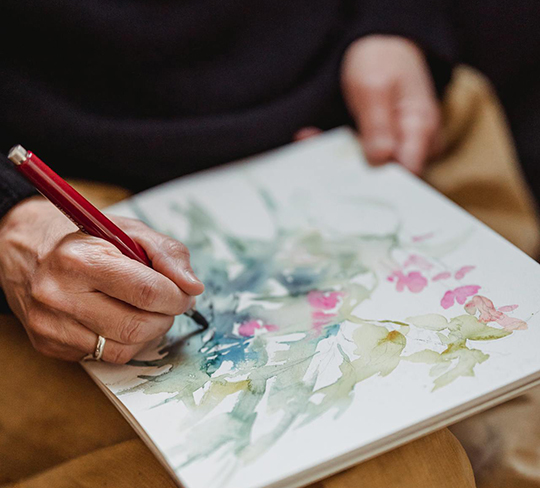
The solution was not another writing method at all. It was five quiet minutes of coloring.
It’s not about 'adult coloring' as a lifestyle trend. It’s not a reward for finishing a draft. It was a small, deliberate ritual that came before words—when the mind was still loud, the body still tense, and language felt too sharp to express what you wanted to say. She would color a simple outline, stop while it was unfinished, and then start writing. The surprising part wasn’t that she felt calmer (though she did). It was that her sentences became clearer—less performative, more specific and more her.
That experience isn’t mystical. It’s practical. It’s especially useful for writers who struggle with perfectionism, self-criticism, overthinking or the feeling that the 'real' story is just out of reach.
Coloring in helps because it gives your brain a simple, structured task. It focuses attention without demanding analysis. Instead of feeling pressured to say something brilliant, you simply ask yourself: 'Which shade fits here?' This type of decision-making is minor, sensory and safe. When the nervous system softens, language often follows.
Why starting with color can unlock your writing
When we begin a writing session, we start by evaluating words. Even if we don’t mean to, we immediately judge the tone, intelligence and originality of the piece, as well as its structure. We try to control the entire piece from the very beginning. For many writers, this desire for control is what causes paralysis.
Coloring falls under that category. It’s structured enough to keep you engaged, yet open enough to allow your thoughts to drift into place. You can be present without trying to solve all your problems at once. In that state, memory and imagination have room to breathe. You don’t force meaning; you create space for it.
The non-verbal nature of color is also important. Writers live in language all day. Sometimes, the fastest way to reconnect with language is to take a brief break from it and engage in a sensory activity that doesn’t argue, demand or require you to “sound right.” Just a few minutes can be enough to shift the internal climate from tense to workable and from brittle to curious.
A five-minute ritual that helps a writer avoid procrastination
The key is to keep it contained. Coloring can easily become a distraction if it turns into a major project. This technique works best when it remains small-scale and focused, much like stretching before a run.
Here’s a technique that has consistently helped writers who are blocked. It’s simple enough to do on a lunch break.
Set a timer for five minutes. Choose a small section of a coloring page, such as a corner, a group of shapes or the edge of a pattern. Choose two or three colors based on your current mood rather than your preference. If you feel scattered, choose muted tones. If you feel numb, choose something bright on purpose. Continue coloring steadily until the timer ends, even if the section looks unfinished.
Then switch immediately to writing for ten minutes. No research or editing allowed. Begin with one truthful sentence about how you felt while coloring. Not what you 'should' feel, but what actually happened. If nothing happened, write that. If your mind wandered, write about where it wandered. If you felt resistance, acknowledge it.
The goal is not to write something that can be published. The goal is to establish a genuine connection from the outset.
Transforming personal images into prompts (the memoir-friendly version)
If you write personal essays, memoirs or narrative non-fiction, you could try starting from a photograph, which can be a surprisingly powerful approach.
Writers often find it difficult to write about memories because they are loaded with emotion, morals and social connotations. A photograph provides a simplified entry point. It provides a framework. However, photos can also feel too concrete or 'literal,' as if you must tell the story exactly as it happened.
This is where converting a photo into an outline can be useful. This process removes some detail, leaving only the essential shapes. This makes the image less like evidence and more like material. Rather than staring at a real person’s face with all its history, you’re looking at lines that can be colored, reimagined, softened or intensified.
If you want to try this, you can use a tool that lets you turn a photo into a coloring page, download the outline, and print it for a short writing session.
Choose a photo that evokes a small emotional response—something you’ve been meaning to write about, but have been avoiding. It could be a childhood kitchen, a pet, a street you lived on, a blurry photo from a party, or a travel memory that now feels complicated. The point is not drama, but truth with texture.
When coloring in the outline for five minutes, pay attention to what you want to emphasise. Are you darkening the background? Are you avoiding someone’s face? Do you find yourself repeatedly going back to one corner? These choices often reveal the subject of the writing before you are consciously aware of it.
Then write in a way that remains close to the image, but without explaining it. Describe what the room smelt like. Describe what you didn't say. Describe what you wish you had noticed. Let the outline be a doorway, not a thesis.
How can color quietly improve your voice?
Writers talk about 'finding your voice' as if it were a rare object, hidden behind the perfect technique. But voice is usually less mysterious than we make it out to be. It is what emerges when you stop performing.
Coloring tends to reduce performance because it puts you in a creative rather than analytical mindset. When you start writing immediately after coloring, your sentences tend to be less filtered. You’re more likely to choose specific nouns. You’re more likely to admit uncertainty. You’re more likely to write what you actually mean rather than what you think a 'writer' would mean.
This is particularly helpful for those who edit too early. If you find yourself polishing the first paragraph until it loses its spark, try making a rule for yourself: don’t reread anything until you’ve written for ten minutes after coloring. Coloring in has already given your brain the satisfaction of 'doing something well.' You won’t need to chase that feeling by writing perfect sentences.
A story tool for fiction writers: using color to create emotional scenes
Fiction writers can use coloring to set the scene. Rather than creating elaborate systems, they should allow the palette to set the emotional temperature.
Think of a scene that you are avoiding. It could feel flat, too intense or oddly resistant. Choose a simple outline—any coloring page will do. Color it in for five minutes, focusing on just one question: What is the emotional weather of this scene? Is it dry and tense? Heavy and humid? Cold and clean? Electric?
When the timer ends, write the scene without trying to be clever. Allow the emotional atmosphere to be reflected in the setting: the sounds in the room, the distance between people and the way the light behaves. Although writers are often taught to 'show, don’t tell,' showing requires presence. Coloring helps you achieve that presence without forcing it.
What this method is and isn’t:
Coloring before writing is not a substitute for craftsmanship. It won’t improve the structure, logic, research or argument of a text. It’s neither therapy nor magic. However, when used in small doses, it reliably reduces the friction that prevents writers from starting.
It bridges the gap between inner experience and language. It is a way to begin without the harshness of “make meaning now.” It is a way to shift your focus from the loud, judgemental part of the brain to the quieter, more observant part—the part that actually notices details and tells the truth.
And because it’s small, it can be repeated. That’s the secret advantage. Rather than needing one perfect breakthrough day, writers need a way to return to the page with less resistance, time and time again, until they have drafts.
Try the simplest possible way once.
Do just this tonight or tomorrow morning:
Choose any outline (printable, pattern or photo outline). Color for five minutes. Stop halfway through. Then write a paragraph beginning with: 'What I didn’t expect to feel was...'
Don’t aim for wisdom. Aim for accuracy instead. If you keep your practice small, it won’t take over your writing time—it will protect it.
The real benefit isn’t the colored page on your desk. It’s the moment you open your document and find that you’re already immersed in your work, quietly and steadily, without having to force your way in.
***