knew this day would come, but that didn’t ease my trepidation. The salty smell of flop sweat mingled with haunting echoes of long-dead drafts and overly revised revisions. Determined, I tightened the strap on my helmet and checked the magazine—fully loaded with fresh ammo—before tossing a final glance over my shoulder shouting, “Cover me…I’m goin’ in!”
In October 2025, despite pro-level procrastination, I hit SEND and entered the query trenches as a debut memoirist. While I didn’t actually wear a helmet or flak jacket, I did ensure I was well armed, and for a nonfiction writer, that meant having a polished book proposal. Completing the monstrous task was no easy feat, partly due to its scope and importance, but also because there just isn’t a ton of info out there on the subject of book proposals.
Trust me, I spent a couple of years looking.
I cobbled together some of the most-referred to references: the venerable Jane Friedman, Writer’s Digest (some of the articles old, some even older), Courtney Maum, and a few esoteric blogposts from days of yore (when folks still ran their own blogs). What I found was, like so many aspects in publishing, there is no “this way or the high way” ipso-facto recipe for the perfect book proposal. Which is cool, considering we creatives like a little leeway to, ya know, create.
There are, of course, best practices—proposal sections no matter how they’re presented that every agent and publisher will expect to see. The data they need to assure them your story is worth the gamble. Because publishing is a bit Las Vegas after all. Toss the dice and see how they roll. Okay, maybe a more apt term is how literary agent Carly Watters’ refers to the industry: venture capitalism. Querying authors are like contestants on Shark Tank. Your query letter is your pitch, and your proposal is the business plan you hand out (in duplicate) to Mark Cuban and Barbara Corcoran when they smile and ask to see more.
As a debut author, there was loads I didn’t know. Full disclosure: I’m one of those self-taught, Internet University, non-MFA writers, so I’ve had a tendency to deep-dive into every aspect of my writing journey. As I revised my completed manuscript, tweaking structure, agonizing on a line-level, hand wringing while waiting for beta readers and critique partners to return feedback, I curated the information I’d learned my proposal required.
My comps list spanned three pages. My bookmarks bar bulged with possible promotional angles. My “Proposal” folder—stuffed with photos and statistics on whom I determined made up my readership—waited patiently to be emptied of its contents.
And still I hadn’t started the stupid thing. Hello, analysis paralysis.
In June as my FINAL_FINAL_(No, Really!).docx draft was being reviewed by my lovely critique partner, I made a commitment that by the end of the summer I’d be ready to query. That gave me three months to attack the dreaded proposal (duh-duh-duhhhnnn). This coincided beautifully with a housesitting opportunity my husband and I lucked into. Nomadic, we typically move house (or countries) monthly, but now we’d be stuck-in at an English country farmhouse, a quiet respite without distraction to focus on the monumental task. My own writing book proposal retreat.
Enter the Dream to Deal Book Proposal Workshop…my actual dream come true. I tripped across this opportunity via Courtney Maum’s Substack and was fortunate enough to snag a spot. This nine-week course promised in-depth coverage of each aspect of a well-honed proposal with weekly feedback; two industry guests: a multi-title nonfiction author and an acquisitions editor; plus an opportunity to craft a query letter AND have that query critiqued by two bonafide, in-the-flesh agents (who even requested fulls from a few of the participants after this live pitch session!). By the end of the workshop, I held a polished, shimmery, comprehensive book proposal and matching sassy query letter in my hands. Figuratively. Who prints on paper anymore?
From the camaraderie, to the accountability, to the insider baseball nuggets, I gained so much more from this formal workshop than my internet rabbit warren diving ever provided. Here are my top tips I learned while crafting the proposal for my travel-survival memoir, to sell the tale of how I survived a climate change-fueled Category 5+ hurricane in the Bahamas:
1. The Overview: Last is Best, but Nail Your First Impression
The overview is the last section you want to write but the first thing an agent/publisher will see. Don’t slide into term paper summary mode, blandly parroting what each category will eventually spell out in detail. Grab your reader from the get-go in scene. This is a chance to flex your creative muscles to explain the origin story of this book (the infamous “Why You, Why This Book, Why Now?” conundrum).
In my hurricane-survival memoir, I originally opened with a voicey epigraph to set the tone. My developmental editor suggested saving it for marketing copy since my opening chapter accomplished the same thing. I bristled, until I positioned the sassy, surprising paragraph as the opener to my Overview to suck the reader in and deliver a little twist in hopes of making the agent want to read more.
2. The Audience/The Market: Hello Ideal Reader – It’s a Pleasure to Meet You
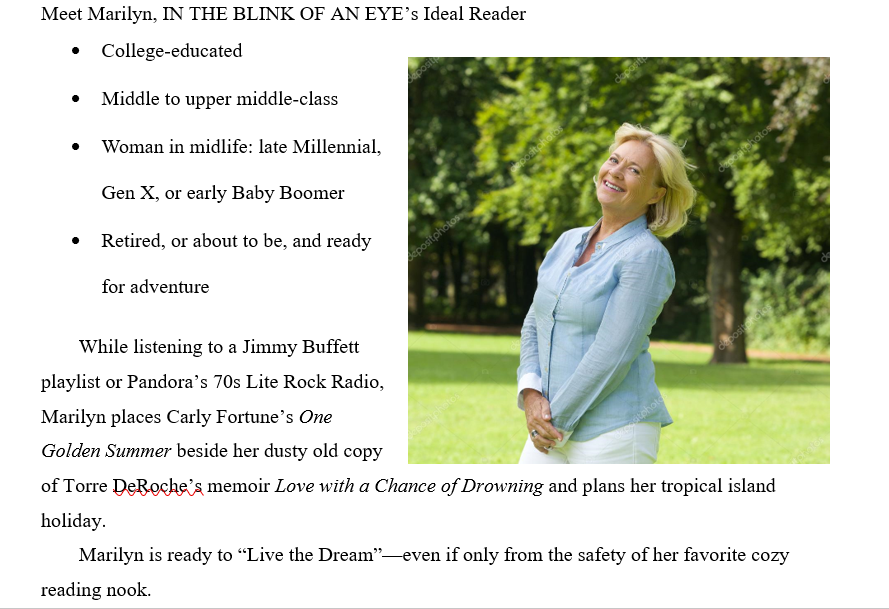
When completing your Audience or Market section, get super granular describing who’s most likely going to buy your book. Picture sitting in front of a room of folding chairs at your local bookshop filled with folks eagerly awaiting your excerpt reading. Who’s sitting in those chairs? Men, women, nonbinary? Young, old? College-educated? Working class? I went so far as to name my educated, well-read midlife woman who loves travel, listed her demographics, included a royalty-free photo, and even placed her in scene to show I have a clear vision of my audience:
3. Marketing & Promotion: By The Numbers – Mining for Outreach
Perhaps the most daunting section of a nonfiction book proposal is the Marketing and Promotion category. AKA capital P-Platform. The “Help Me Help You” juggernaut that is the bane of every nonfiction author trying to traditionally publish today. THE MISSION: Create an unforgettable, moving, wholly unique story that resonates across a wide demographic; make it voicey so this and future works can be easily distinguishable (read: brand-able); oh, and come to the table with a built-in fan club, drooling in anticipation of the release date, eagerly waving their greenbacks and queueing up for author signing events. No wait, we need them—hundreds if not thousands of them—to pre-order so there’s a Hail Mary chance your book baby hits a bestseller’s list.
No pressure.
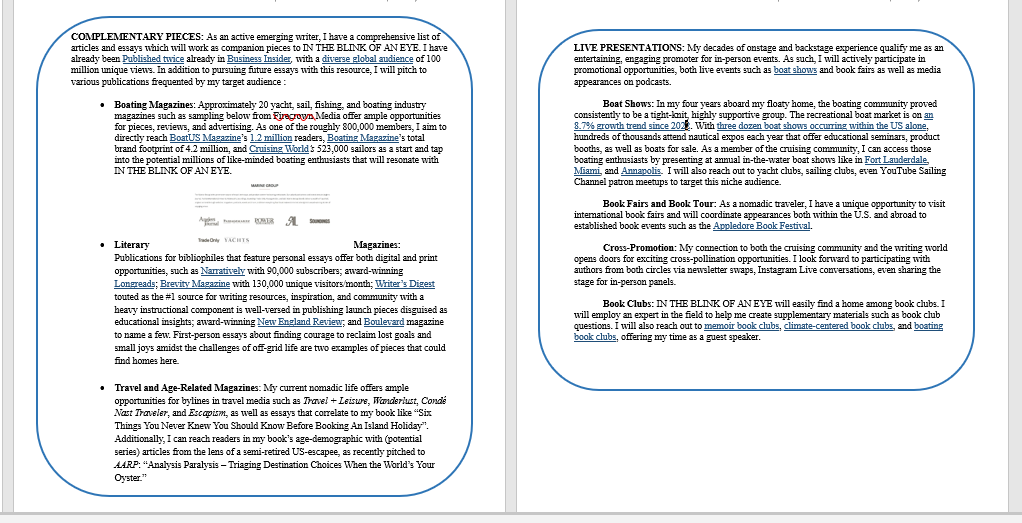
The Marketing and Promotion section is where you show agents and publishers your ability to reach said ravenous fans. Common sense dictates you reveal your social media followers, newsletter subscribers, website visits. But you can sweeten that impression by illustrating solid growth (have your posts been read, restacked, or shared more of late?), or if you’ve had one post do very well (please go viral, please!), or by piggybacking on those who have a larger platform than you.
Now don’t get me wrong, I am NOT condoning lying in your proposal. Don’t be fudging numbers or claiming you know so-and-so author who’s certainly going to promote your book to her 400,000 online “friends” unless you are lucky enough to be besties with an influencer. But much like my claims of being 5’5’’ and 110 lbs. on my resume when I danced professionally in my twenties, there’s nothing wrong with a little aspirational extrapolation. I could have hit those goals if I’d starved myself for two weeks (not that I would) and hung upside down for 20 minutes right before stepping up to the measuring tape. Similarly, you can show numbers from platforms you (realistically) think you can mobilize to reach a wider readership.
Are you in conversation with (online, taken classes from, etc.) authors who have a strong platform and followers who would like your work? Hitch yourself to a bigger wagon by illustrating how you might access that potential to boost your total reach. Do you write a column for a regional zine or have you published for a national imprint? Include their total readership along with ideas (I recommend suggesting article titles) you’ll pitch for complementary pieces to run just prior to launch date. Cross-pollinate: are there Substack newsletters similar in theme or substance to your book you could reach out to that might participate in cross-promotional posts? Include their subscriber numbers as an audience you will court in your PR efforts. Events, interviews, groups (yes, book clubs)…Remember, this is a business plan.
Just like convincing a bank to lend startup capital to open a new business, you must convince the agents and publishers that you (and your story) are worth investing in. Vegas, baby!
4. The Big Ask: Blurbs and Endorsements
Don’t wait until a year or so before your book’s launch date to seek promotional affirmation. Show your marketing chutzpah by reaching out and securing some peer brags to include right there in your proposal. I know, I KNOW. It’s terrifying. But your willingness to self-advocate and self-promote, engaging with other authors, experts in your field, and influencers who may toot your horn for you, signifies how far you’ll go to make your book a success. Plus, it’ll be easier to send those cringy emails closer to your pub date if you’ve already broken that ice.
5. Make Pretty, but Don’t Overwhelm
Just because a book proposal is a serious document filled with statistics, demographics, and data (oh my!) doesn’t mean it has to be banal. Some proposals are all text; that’s fine. There are no rules. But adding photos (if pertinent) and/or graphics (e.g. a graph illustrating an increase in stories on your book’s topic, showing a rise in reader interest) can add impact to the sea of numbers and hyperlinks1.
Sprinkle a dash of creativity to break up the mundane parts and keep the reader interested without going over the top. Separating sub-sections in your Marketing segment with a subtle border? Cool. Filling in the background with a “brand color” and a few emojis? Not cool. Avoid cutesy and cheesy. Stay out of Canva and PowerPoint. The goal is to enhance the seemingly run-on blocks of text for ease of reading, not to detract from the substance of what’s on the page.
1BONUS TIP: Don’t go all Boomer and add your supporting data as footnotes, like this one. Slap that info right into the body of your text via hyperlinks to prove your case without stopping momentum, to keep the agent/editor reading. And while you’re at it…
BONUS TIP 2: Hyperlink your Proposal’s Table of Contents directly to the corresponding sections. Agents and acquiring editors will navigate a book proposal from differing perspectives and may revisit sections. Granting easy access to jump between categories makes deciphering your proposal a breeze, which will be greatly appreciated by overworked gatekeepers with bleary eyes.
I hope these tips are useful. So far, as a noob querying writer, I’ve submitted to 10 agents and received 2 requests for fulls, which indicates my query letter is (sometimes) doing its job: seducing the agent to want to see more. And of course, the query letter was composed after I completed my proposal and saw, with confidence and clarity, what my project was, where it was going, and how I will help bring it into the world (fingers crossed). I wish the same confidence and much success for you.
For those interested, the wonderful experts I learned from, Hanna Howard and Kelsey Erin Shipman, are offering their next Dream to Deal Book Proposal Workshop starting January 28, 2026, with a free info session on January 20, 2026.
***
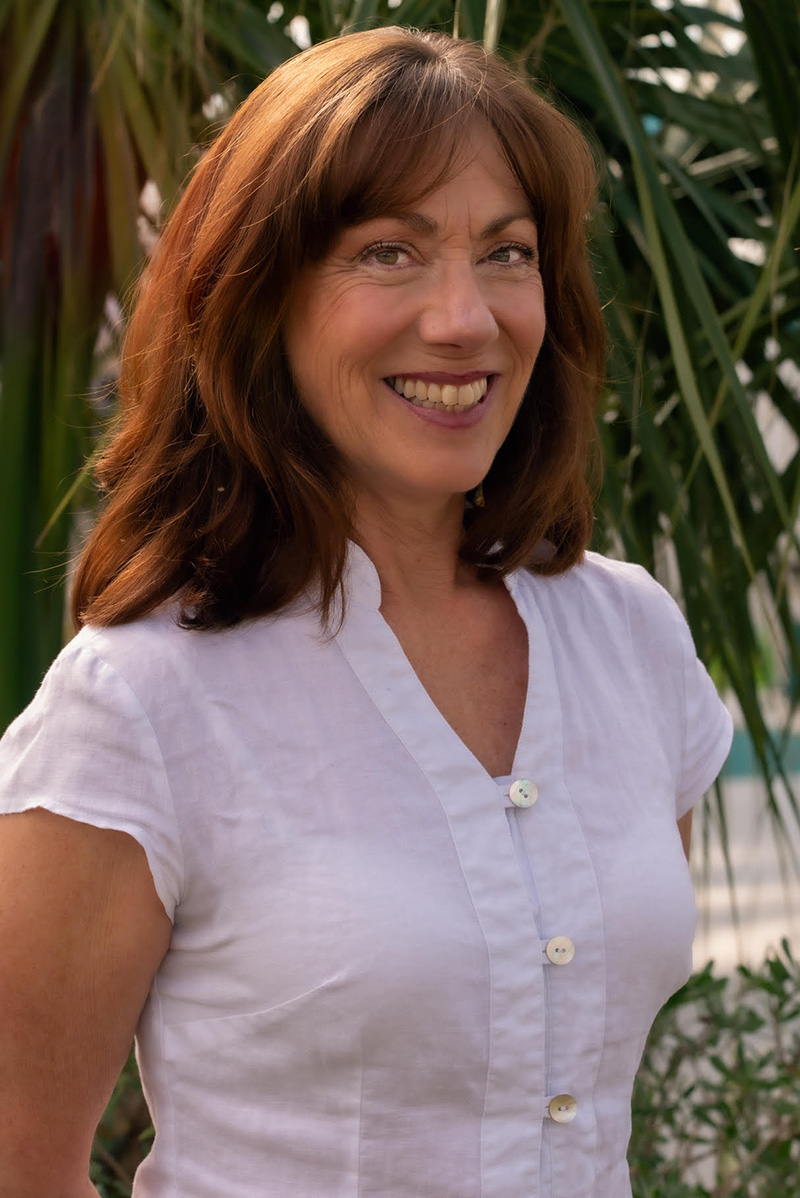
Wendy Hawkes (She/her) is a nomadic prize-winning essayist exploring resilience, reinvention, and life lived off the beaten path from her ever-shifting home base. She is a member of the National Association of Memoir Writers and her personal essays have achieved Finalist status in various competitions, including Second Place Winner in Writer’s Digest 2023 Personal Essay Awards. For years she lived fulltime on a boat cruising the islands, collecting bylines like Business Insider and The Good Trade, even recording a guest spot on Writing Your Resilience podcast from aboard her floaty home. Now she slow-travels the world with her fellow-writer husband, having finally embraced the freedom of being permanently unmoored.